
The earlier reports are as follow:
Part 0: Planning
Part 1: Setting foot in Seoul
Part 2: Skiing in Yongpyong
Part 3: COEX Aquarium & Namsan Tower
Part 4: The Korean DMZ
Part 5: Visiting Changdeok-gung
Gyeongbok-gung
This is the last full day of our trip in Seoul. We spent the whole day walking in and around the palace ground of Gyeongbok-gung. The palace is slightly smaller than Forbidden City in Beijing, China, but is still quite huge.
To reach the palace, take Seoul Subway's Orange line to Gyeongbokgung station and use exit no 5. You'll exit around 150m west of the main gate. Make sure you reach the palace main gate 5 to 10 minutes from the hour, as there will be hourly change of guards ceremony from 10 am to 4 pm.

Note the difference in the palace layout with Changdeok-gung. Gyeongbok-gung palace follows the traditional orientation of palaces in China, in which the centre axis of the palace follows closely in the North-South direction, with the main gate facing the South.
As pointed out in the earlier post, the Japanese occupation in the early 1900s destroyed many of the palace buildings. Reconstruction effors are still ongoing when we visited in mid Jan 2014. Therefore, there are still large areas of empty land in the palace grounds.
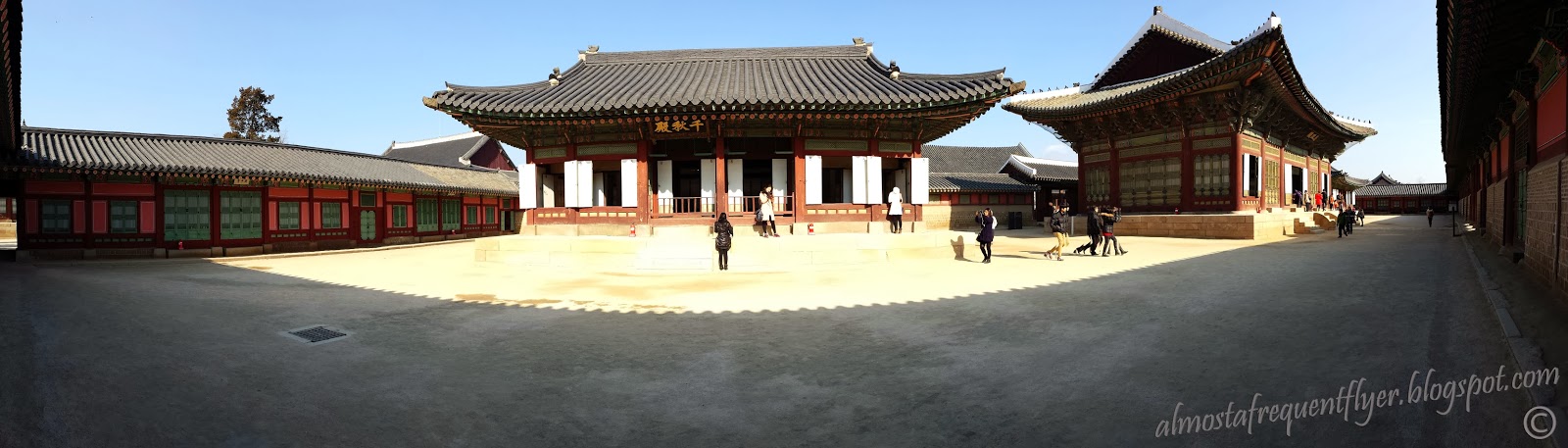
The main gate of the palace is named Gwanghwamun, from which visitors enter. From there, there are 2 more gates, Heungnyemun and Geunjeongmun before you reach the outer court, where the Throne Hall (Geungjeongjeon) is located.
Behind the Throne Hall is the inner court where the king's and queen's quarters lies. Also here is where the king's mother's quarters are located.



We spent the rest of the morning and early afternoon exploring the palace ground, after which we went to the National Palace Museum of Korea located on the south-western corner of the palace. If you're a history buff and like to spent hours looking at historical exhibit, then this is the place to learn all that there is on Joseon dynasty and royal life. And not to mention, admission is FREE!!! You can opt to sent an automatic audio guide (activated by RFID) for KRW 1,000 (USD 1), which is extremely value for money for the wealth of information you're going to get.
Another museum located in the palace grounds is the National Folk Museum of Korea, but since we do not have the time for 2 museums AND the palace grounds in 1 day, we decided to skip that for now. But it should be worth checking out for those who are interested in Korean folk history.
Directly opposite the Gwanghamun is an underground complex highlighting the life of King Sejong the Great and Admiral Yi Sun-Sin, both being prominent characters during the Joseon Dynasty. Again, if you have the time, this is also worth visiting.
Around the corner from Gyeongbok-gung is one of the most famous Korean Ginseng Chicken (Samgyetang) restaurant in Seoul called Tosokchon. As it is ranked number 17 in Seoul on Tripadvisor, you will not only find a long queue in front of the restaurant during the lunch and dinner hours, you will also find that most of their customers are tourists. Nevertheless, there are still a handful of local Seoul-ites in the restaurant when we visited at around 3pm (which is somewhat a good thing).
The soup is cooked with an assortment of herbs and has a rather milky or creamy texture. The chicken itself is stuffed with Korean Ginseng and glutinous rice, which give the soup it's creamy texture.
To most of us from Singapore who are more used to the clear type of ginseng soup, the soup may be some sort of a surprise. So due to this, I rather have a mixed liking to the soup. On one hand, the taste and smell of the herbs is heavenly, but the milky texture is something which I need to grow to like. The chicken though, is heavenly. Cooked to perfection, the meat is easily separated from the bone, but not overcooked until it's mushy.
As with many restaurants in Korea, there is always kimchi with an assortment of other side dishes served with the main course. Lastly, a note for those who want to avoid carbs or wanted to try more Korean street food(who wouldn't?), the glutinous rice can be VERY VERY FILLING.
Unfortunately, for dinner that night, we randomly chose a restaurant and ended up with a rather unimpressive one in Myeongdong, which isn't worth mentioning. But my wife did end the day happy with all her shopping which we leave until the last night. We also pop by Lotte Supermarket to buy tidbits to bring back to home.
The next morning, we woke up early for our 11 am flight to KUL and SIN. We took the same bus from the hotel to Incheon Airport and checked in without fuss using the business class counter.
What took us by surprise was the queue to clear airport security and immigration. It took us almost 30 minutes to clear both security and immigration, leaving us almost no time to do our tax refund and enjoy the business class lounge. As an airport which consistently ranked within the top 5 airports in the world, I don't understand how can this go so badly.
Thankfully, everything went smooth after that. We boarded and found our seats at the front section of the aircraft, enjoyed the pre-flight drinks and pushed back from the gate on time.
As usual, the food served onboard is excellent. Never once we felt hungry on the flight.


After an uneventful 6 hours flight, we landed at KUL and proceed straight to the newly renovated KLIA Golden Lounge at the Satellite Terminal. The lounge is huge and has plenty of food and drinks available. 3 hours later, we boarded the B737-800 for the last leg of our journey home.
To reach the palace, take Seoul Subway's Orange line to Gyeongbokgung station and use exit no 5. You'll exit around 150m west of the main gate. Make sure you reach the palace main gate 5 to 10 minutes from the hour, as there will be hourly change of guards ceremony from 10 am to 4 pm.
Note the difference in the palace layout with Changdeok-gung. Gyeongbok-gung palace follows the traditional orientation of palaces in China, in which the centre axis of the palace follows closely in the North-South direction, with the main gate facing the South.
 |
| Changing of guard ceremony |
The main gate of the palace is named Gwanghwamun, from which visitors enter. From there, there are 2 more gates, Heungnyemun and Geunjeongmun before you reach the outer court, where the Throne Hall (Geungjeongjeon) is located.
 |
| Heungnyemun |
 |
| The outer court with the Throne Room in the centre. The effect on the picture is because we used the Surround Mode on Galaxy Note 3's camera which gives the effect of Google's Street View when viewed on the phone. This is "flattened" version of the image. |
Even though the throne room is not the original one, it is still very impressive, with various paintings and carvings lining the walls and ceiling. The throne itself sits at an elevated platform and has all the makings of the seat of power of a dynasty. We didn't take any pictures of the throne room because there are throbs of tourists who are packing the front of the room, making it very difficult to take any decent pictures of the room.
Behind the Throne Hall is the inner court where the king's and queen's quarters lies. Also here is where the king's mother's quarters are located.
We spent the rest of the morning and early afternoon exploring the palace ground, after which we went to the National Palace Museum of Korea located on the south-western corner of the palace. If you're a history buff and like to spent hours looking at historical exhibit, then this is the place to learn all that there is on Joseon dynasty and royal life. And not to mention, admission is FREE!!! You can opt to sent an automatic audio guide (activated by RFID) for KRW 1,000 (USD 1), which is extremely value for money for the wealth of information you're going to get.
Another museum located in the palace grounds is the National Folk Museum of Korea, but since we do not have the time for 2 museums AND the palace grounds in 1 day, we decided to skip that for now. But it should be worth checking out for those who are interested in Korean folk history.
Directly opposite the Gwanghamun is an underground complex highlighting the life of King Sejong the Great and Admiral Yi Sun-Sin, both being prominent characters during the Joseon Dynasty. Again, if you have the time, this is also worth visiting.
Around the corner from Gyeongbok-gung is one of the most famous Korean Ginseng Chicken (Samgyetang) restaurant in Seoul called Tosokchon. As it is ranked number 17 in Seoul on Tripadvisor, you will not only find a long queue in front of the restaurant during the lunch and dinner hours, you will also find that most of their customers are tourists. Nevertheless, there are still a handful of local Seoul-ites in the restaurant when we visited at around 3pm (which is somewhat a good thing).
 |
| There are only 3 items on the menu in Tosokchon |
To most of us from Singapore who are more used to the clear type of ginseng soup, the soup may be some sort of a surprise. So due to this, I rather have a mixed liking to the soup. On one hand, the taste and smell of the herbs is heavenly, but the milky texture is something which I need to grow to like. The chicken though, is heavenly. Cooked to perfection, the meat is easily separated from the bone, but not overcooked until it's mushy.
 |
| Samgeytang served in stone pot, which retains heat well and keeps the soup warm |
Unfortunately, for dinner that night, we randomly chose a restaurant and ended up with a rather unimpressive one in Myeongdong, which isn't worth mentioning. But my wife did end the day happy with all her shopping which we leave until the last night. We also pop by Lotte Supermarket to buy tidbits to bring back to home.
 |
| The most expensive apple i've seen. KRW 88,000 (USD 88) for 12 pcs |
 |
| No queue for business class counter |
Thankfully, everything went smooth after that. We boarded and found our seats at the front section of the aircraft, enjoyed the pre-flight drinks and pushed back from the gate on time.
 |
| Our ride to KUL. Another Airbus A330-300 |
 |
| Full load, even in business class |
After an uneventful 6 hours flight, we landed at KUL and proceed straight to the newly renovated KLIA Golden Lounge at the Satellite Terminal. The lounge is huge and has plenty of food and drinks available. 3 hours later, we boarded the B737-800 for the last leg of our journey home.
Note to my readers, I've been rather busy with work commitments lately. Once I have the time, I will post my food experience in Seoul. Also, I've another upcoming post on Penang, which I visited 2 weeks ago. Look out for it here.


